Peggy: Hypothermic in Colorado
“A friend and I, both with lots of experience, were backpacking in Colorado. It had rained all day, and in the mid-afternoon, we decided to get to our closest possible stopping point, a campsite that was about 2 miles further, on the other side of a 1200-foot hill.
We started up the hill, and my friend was hiking very, very slowly. We stopped, ate, drank, and rested a bit. When we started again, she was still hiking very slowly. I realized something was off and that we just needed to stop. However, we were on the side of a forested mountain, and there was nothing resembling an open spot for a tent anywhere.
After about 10 more minutes, I saw two very small openings down off the trail, so we went down and set up our tents.
At that point, I realized we didn’t have much water; the campsite we had planned on was next to water, so we weren’t carrying much up the hill. I left for about 45 minutes to go back down and get water.
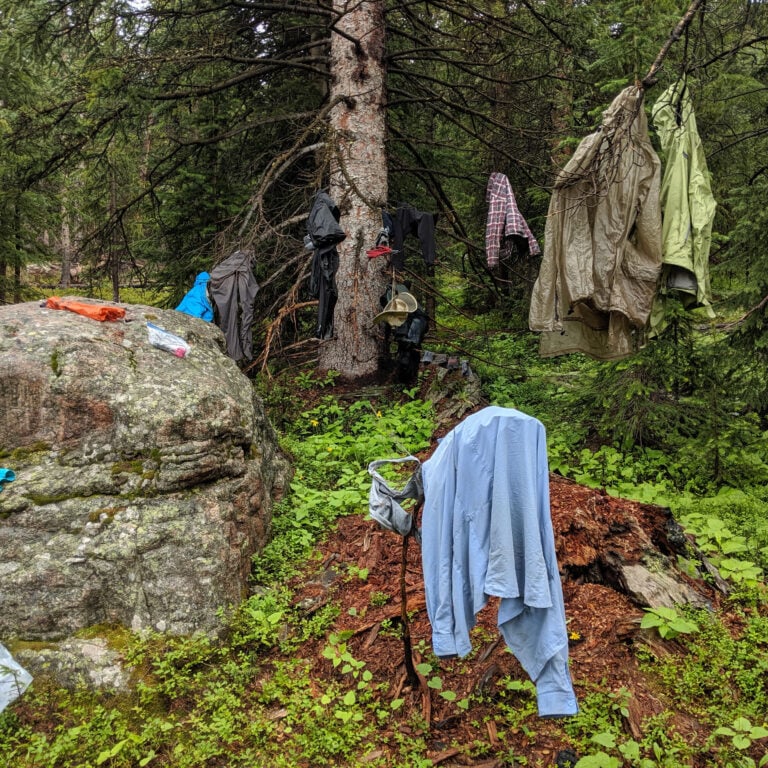
When I came back, I called for my friend, but she didn’t answer. I looked in her tent, and she was wrapped in her sleeping bag, shivering violently, and her lips were blue. It turned out that she had old dry bags for her gear, and they had failed, and everything was soaking wet.
Hypothermia time!
I had my friend strip off her wet clothing, and I went and got my wet stuff out of my tent, as much as possible. Then she put on my dry sleep clothes and climbed into my dry sleeping bag.
Five minutes later, my friend is still shivering violently and is not making much sense. She drank hot water and some instant mashed potatoes, and that helped a little bit, but she was still shivering and blue.
At that point, I considered pushing the button on my beacon to notify SAR, but realized that it was almost dark, and they probably wouldn’t start a rescue until first light. That would be too late for my friend.
I was about to strip off my clothes and climb into the sleeping bag with my friend, as the last thing I could think of to do. She was very hypothermic with dry clothes, a dry sleeping bag, and something warm to eat. Why?
I finally asked if she had taken off ALL of her clothes, and dried her hair? She hadn’t dried her hair, and more importantly, still had on a sort of base layer made of…. cotton!
She was able to slowly remove all of her clothes and put my still pretty dry clothes back on. That fixed the problem!
We brought her sleeping pad in, and shared my sleeping bag in my one-person tent, and it was surprisingly warm that night.
In the morning, we were able to hike the 12 miles into town and dry out completely.
Lessons learned: The big lesson that I learned was to communicate better with a hiking partner. If I had asked more about what was happening as we were hiking slowly up the hill, I wouldn’t have left for water until my friend was OK. I didn’t realize she was soaking wet, and so was all of her stuff, and she was just completely out of energy.
Also, when someone is hypothermic, or dehydrated, or having heat stroke, they can’t assess their condition, and often can’t think to tell someone else that they need help. I had read a lot about hypothermia, and I think that helped me take most of the right steps for treatment.
It also made me realize that there are times when SAR will probably just take too long, so it’s up to you.
Finally, replace your gear periodically (dry bags), and remember “cotton kills”!
But it didn’t this time!”
– Peggy, Survival Med Student